Introduction :
The Dynamic Steady State (cellular) Universe (DSSU Theory)
I was astonished in 2008 to discover the Dynamic Steady State Universe (DSSU) theory proposed by the brilliant Canadian cosmologist, Conrad Ranzan. At the time I was in the midst of my on-going massive digital mural, Cosmic Tree of Life, Version 2.0 (CTOL), a cosmic additive work (in progress) begun in 2003. The DSSU theory excited me because it's foundation embraced a Steady State natural cellular universe. There were visual elements (web-detail) in my CTOL mural that extraordinarily resonated with DSSU theory, causing me to personally contact Conrad Ranzan. We immediately embrdaced a working collegiality and communication that abides to this day. He went on to school me with all the postulates and particulars of DSSU theory, cementing between us an art-science common purpose tied to respecting each others abilities.
The Dynamic Steady State Cellular (infinite) Universe, from the moment I began to understand it's profound natural realism, struck me as a revolutionary cosmology an the first ever to embrace a cellular universe. I was strongly drawn to his science realism, daring and innovation based on an all hands on deck tour d' force revolution amid the plethora of existing cosmologies. Ranzan embraces in depth rigorous scientific research and a profound understanding of philosophy, physics, mathematics, astronomy and cosmology.
DSSU theory is best described by accessing an easily navigated web site that cosmologist Conrad Ranzan offers with well written prose beautifully buttressed by his bountiful excellent illustrations. I recommend gentle readers access the following links:
http://www.cellularuniverse.org/
https://thenewcosmology.wordpress.com/
http://www.cellularuniverse.org/Th8PE-DSSU-Ranzan(2014).pdfAfter several years of DSSU study and thoughtful schooling by Ranzan, I had the pleasure of eventually reading and reviewing many of his on-going papers. This includes reviewing all 13 chapters of his first book, "Guide to the Construction of the Universe" (2014). DSSU theory is one of a kind among the many cosmologies out there in the midst of a dominant inflated Big Bang (BB) orthodoxy, now in it's 80th year. Above all, I was elated to find DSSU theory strongly poised to suck the oxygen out of an outlandish BB inflated universe allegedly born 14 billion years ago.
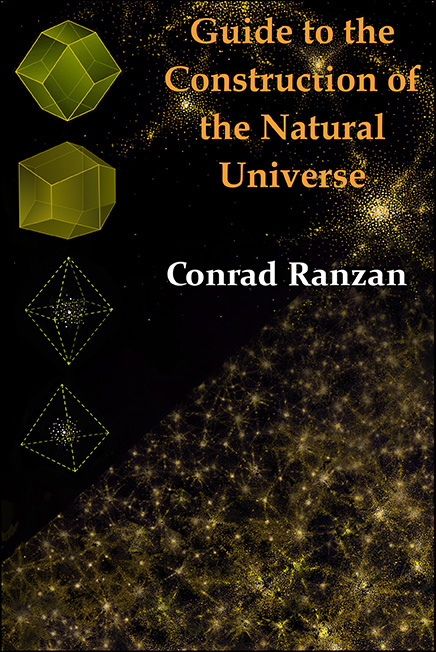
In the main we enriched each others work because I was well read in science and cosmology so our exchanges were evermore fruitful as I gained greater understanding of DSSU theory. I designed the cover for his book and created several physical DSSU models and other visuals. This only led positive fire to the exchanges that flourished between us.
All in all, it was a fascinating learning period for me as well as it exemplified very close rewarding collegial communication between scientist and artist that can be accessed below between scientist Conrad Ranzan (CR) and artist, Roger Ferragallo (RF). Following is a documentation of highlights in our correspondence from 2008 to 2014.
----------------------------------------
6-1-08 cr to rf
Dear Roger:
After viewing your impressive biography I must congratulate you on your many achievements. Thank you for your interest in my work.
The hidden gem in the attached paper, as you will see for yourself, is that it reveals the unambiguous cause of galaxy rotation. An explanation of the acquisition of large scale rotation by galaxies eludes all other theories of the universe (and specifically those detailed on the webpage www.CellularUniverse.org/UniverseModels.htm. The paper has been peer reviewed.----------------------------------------
6-12-08 rf to cr
Dear Conrad:
It is most generous of you to personally send me the extended "Story of Gravity and Lambda". Again, I'm grateful that this paper is not filled with mathematics. I appreciate your writing and the clarity of your prose. I stand in awe of your profound ideas and look forward to absorbing this important paper. You write with the clarity of a Loren Eiseley.
Interesting, that the evening I read your paper, I also found this: "According to the European Southern Observatory (ESO), "All recent computer-simulations of the early universe have one prediction in common: the first large-scale structures to form in the young universe are long filaments connected at their ends in 'nodes'. The models typically look like a three-dimensional spider's web, and resemble the neural structure of a brain."
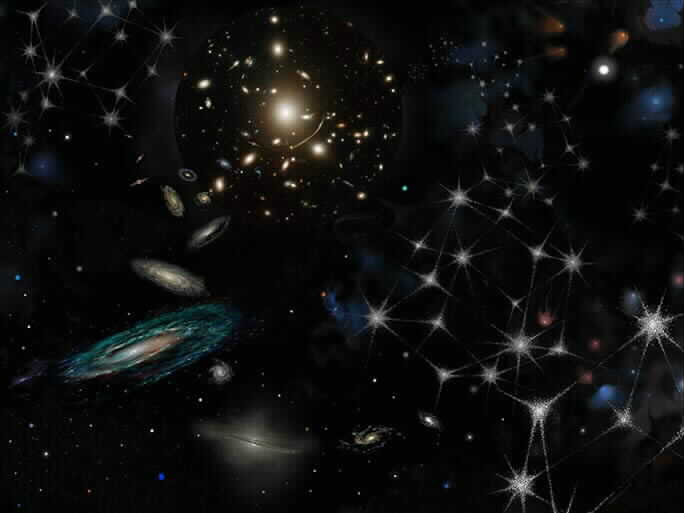
I found this fascinating because in my "Cosmic Tree Of Life" painting, I imaged a large web like nodal structure that follows a swarm of organic molecules found in interstellar space. This was a visual concept I intuited in 1994 before I had any notion of Chandra's actually showing filaments stretching for millions of light years through space, with one, I understand, passing through our own Milky Way Galaxy. Art and Science do have intimate connection with each other, i.e., Leonard Shlain, Art & Physics...
Parallel Visions in Space, Time & Light, 1991.
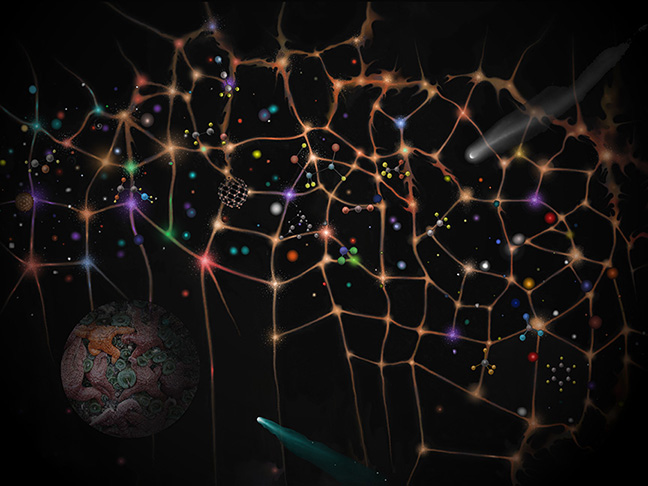
Ferragallo Cosmic Tree Of Life ver.2.0 (Detail, left quadrant) ferragallo.com
-------------------------------------
9-28-08 rf to cr
Dear Conrad:
Thank you for the compliments on Cosmic Tree Of Life (CTOL) as a "consciousness raising celebration"...I appreciate this coming from a scientist of your stature. I'm currently back at work on CTOL version 2.0. I should have this ready by next February. Though this painting is currently seen on the Carnegie Mellon site as if it were a finished product; in actuality it is still in process. When I complete 2.0 which was launched to improve the high resolution plasma and other patterns; I will begin another 3.0 phase that will introduce more literal content, ideas and imagery. Like no other painting, CTOL is a philosophical work that combines science, astronomy and cosmology! I would like to think that more artists and poets will take on the awe inspiring subject matter of the astonishing cosmology being revealed by scientists such as yourself.
-----------------------------------------------
Note: (Cosmic Tree of Life Video--HiPerSpace Screen, Univ.of Calif. San Diego)
http://www.youtube.com/watch?v=awkGbvBz30I (VIDEO)
http://www.ferragallo.com/tol_index.html (CTOL)
5-12-09 cr to rf
Dear Roger:
I want to congratulate you on having your visual art displayed ---or should I say performed--- at the U. of California. I did view the Cosmic Tree of Life (CTOL) (thanks for the convenient link). The art work is stunning to say the least; the message is profound. I only wish I had highspeed.I've been thinking about the parallels of our work: We are both trying to understand the universe and present our understanding to those people who have thought seriously about the issues and (not to be exclusive or elitist) to people who just might be inspired to delve deeper.
I take you seriously when you say "version 3.0 will introduce more literal content, ideas and imagery. ... CTOL is a philosophical work that combines science, astronomy and cosmology!"I like your self-challenge: "Now how do I bring the visual painter to task here?"
Now here is something I cannot over stress. Our universe does not have a beginning and it does not have an end. However, everything in the universe has a beginning and an end. But what is most amazing is that the universe embodies continuous 'beginning' and continuous 'ending'. What this means is that the symbolism of a "cosmic egg" is not the best. Although it is a popular representation, it is misleading if the purpose is to portray reality. The new representation of perpetual formation and balancing destruction is where the artist will be brought to task!
What about the stuff in between? ---between vast numbers of quantum beginning events on the one hand and numerous suppression-annihilation events on the other? This is the domain of all evolution. This domain I see represented by your Cosmic Tree of Life. The roots with the hair like tips represent matter formation events. The root network represents the evolution of subatomic particles towards basic matter. The trunk is the transitional link between basic matter and organic matter. The branching pattern traces the evolution of astronomical objects as well as the evolution of all forms of life. The branch or leaf tips 'connect' to blackness ---a connection that symbolizes the flow of some object, large or small (or, more likely, its ashes), as it is absorbed into some terminal-type black hole (the ones with the SU-AN cores). Now picture this tree growing continually but never becoming bigger!
As I'm sure you can appreciate we are at a new level of consciousness and awareness. (And I'm not referring to anything esoterical or new-age religious.) My chosen purpose is to understand and formulate cosmic reality. Your chosen purpose seems to be to share the understanding and bring it to life through all the means available to the 21st century artist. (If I'm being presumptuous and my ideas do not fit into your plans for version 3.0 then I will hope for a version 4.)
I want to, very briefly, present to you my idea of the three levels of visualization or representation of the images/DSSU (the cellular Universe):
1. The steady state (almost static) aspect: This is the 'landscape view' of the endless receding view of cellular structure. A 3-D web-like structure with a degree of irregularity.
2. The dynamic aspect: a typical cosmic cell somehow portraying the perpetual flow that sustains the cell. The continuous 'beginning' balanced by the continuous 'ending'. Symbolism involving birth, evolution of matter, evolution of complexity, evolution of conscious life, death.
The dynamic picture includes the central space expansion balanced by a shell of space contraction.
3. The consciousness aspect: this picture must try to capture what is probably the most profound concept imaginable. In the evolution of life some branches attain consciousness. There is also a special kind of consciousness. When life, life being a part of the universe (as in the popular expression, we are made of stardust), reaches the level of at which it asks questions of the universe (as we are doing) then that life-form actually represents the universe being conscious of itself!
Wishing you continued success,
Your friend,
Conrad Ranzan
P.S. Pardon the Canadian spelling.------------------------------------
6-16-09 cr to rf
Dear Roger...You actually bring up an excellent point. The regularity is there and supported by theory and evidence but admittedly IT LOOKS SO DISTORTED. There are many sources of distortion with respect to direction, brightness, and redshift of the multitude of galaxies whose distribution establish the dodec shape. Our own galaxy, as you mentioned, partially blocks our view......Here is an interesting and relevant experiment that suggests, in an analogous way, how an orderly universe can appear disorderly. If you have ready access to the materials required, I would encourage you, the artist, to try it.. I'm hoping that even with the glass 'balls' placed in a perfectly regular pattern, the whole will appear totally chaotic from certain angles. It would then serve as a wonderfully simple analogy for the cellular universe. (I've never tried it but I would love to see the results.) The results would be useful to both of us.
And with respect to the difficulty of finding transparent spheres: Simply using transparent marbles should work ---provided the camera can handle extreme close-up shots. And as long as they are all roughly the same size.
And you are right, it could be done with computer graphics------------------------------
7-30-09 rf to cr
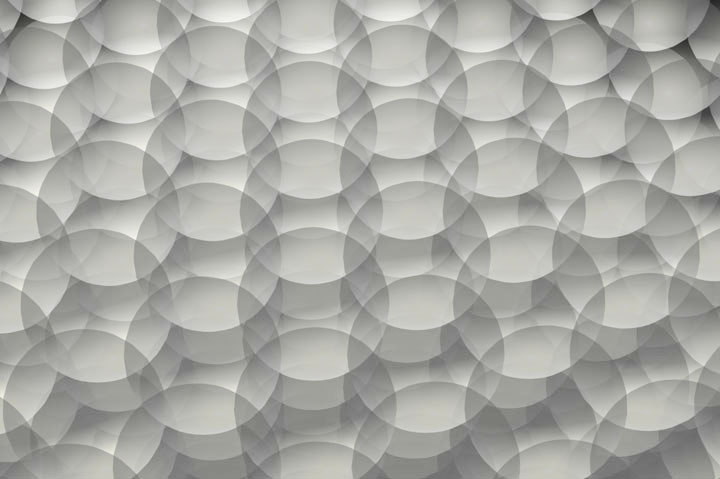
(3 images: computer generated transparent spheres to represent closest cell packing illusions )
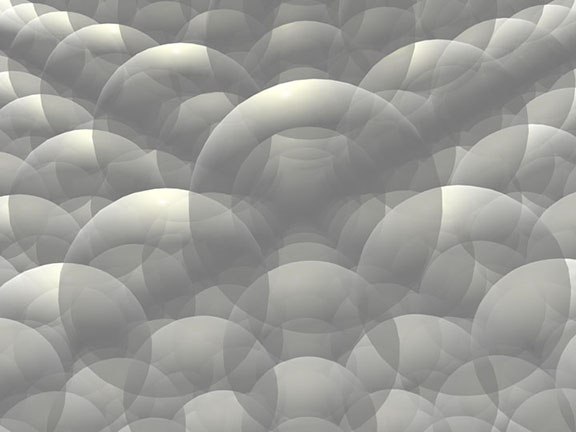
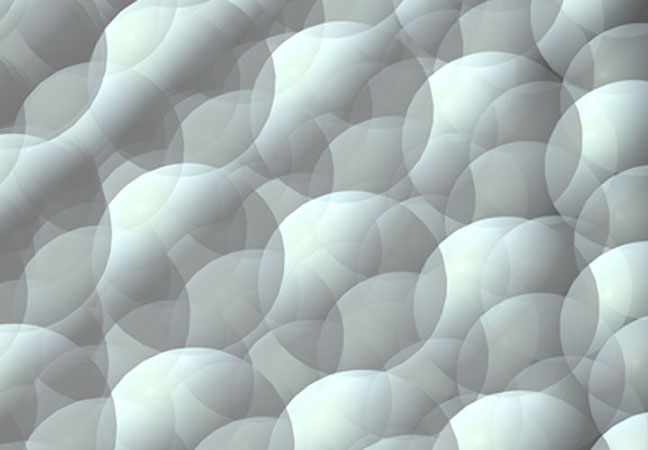
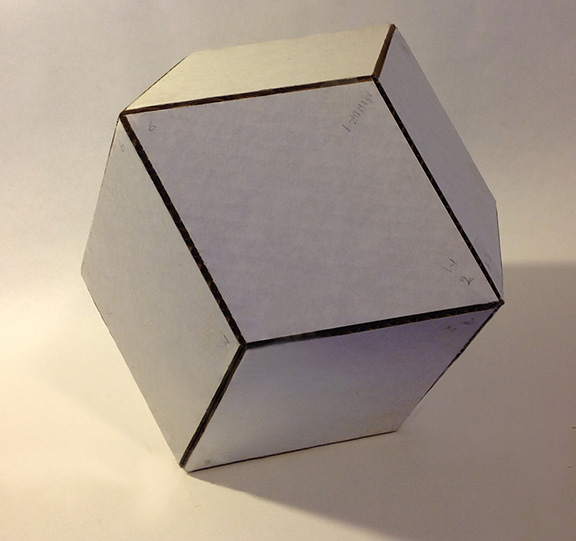
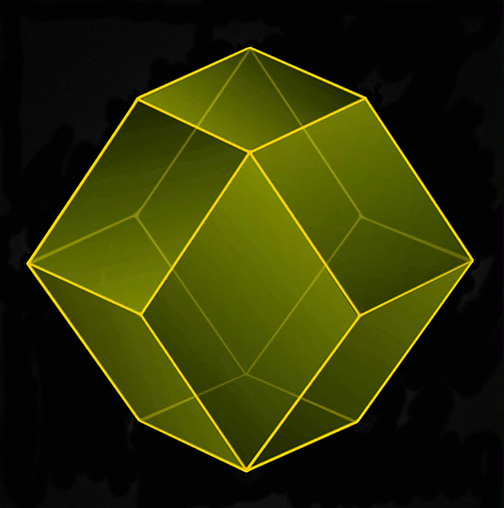
Dear Conrad: I'm enclosing the experiment regarding the transparent spheres we discussed exemplifying closest packing of cells. Your suggestion to experiment with clear glass spheres, marbles and spherical objects has been difficult. Computer generation is the best answer. The 3 attachments are cropped from larger sphere masses and of course exist at very high 300 dpi resolution should they prove useful. It's a starter and I will keep trying if these examples miss the mark. I'm currently experimenting with the cell dodec and have constructed a large rhombic dodecahedron that can serve as a template for constructing a wire form to model the cell unit to express varied angularity as suggested. (dodec image)
----------------------------------------
(Note: 10-05-09 cr to rf)
Dear Roger: OK the "paper" you are quoting from is actually Chapter 1 of a 22 chapter manuscript; my original manuscript entitled: images/DSSU --the New Cosmology. The original plan was to post all the chapters. (But the plan was changed. Keep in mind that the chapter develops the idea of cosmic spheres or "bubbles" conceptually transforming into dodec. Part of the reason for doing this is that in later chapters I use the cosmic sphere to deal with some mathematical aspects (the equillibrium between expansion and contraction) which would be practically impossible with a dodec.
------------------------------
6-4-09 cr to rf (initial email exchanges)
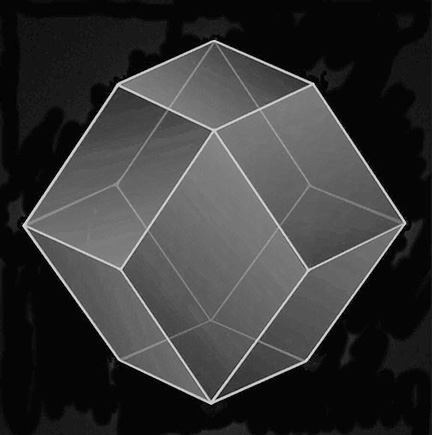
Dear Roger: Rhombic dodecahedron. Simply cut, fold, and paste it together. You will find it to be a fascinating shape..."
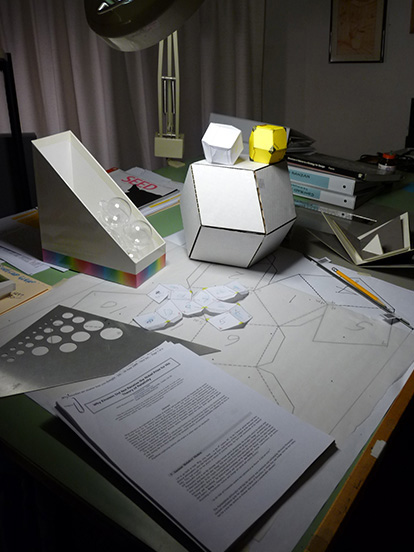
ferragallo construction RD studies ferragallo rhombic dodecahedron (RD)
6-4-09 rf to cr
Conrad...yes a most interesting shape--so simple yet mysteriously complex when viewing it at various angles. cubes, asymmetric and symmetric views that bewilder the mind! Here, the RD (front 3 faces) to the right has the appearance of a cube! Amazing!
---------------------
6-6-09 cr to rf (initial email exchanges)
Dear Roger: In the year 2001, I found myself captivated by the challenge of the dark matter dark energy mystery. The breakthrough came in August of the same year with the uncovering of the 4 fundamental processes of images/DSSU theory. The breakthrough led to a new steady state model of the universe and the website ---www.CellularUniverse.org--- which promotes the new cosmology.
---As far as I am aware, I am the only 'scientist' conducting research on images/DSSU theory; and you, Roger, are the only 'artist' exploring the aesthetic perspective of images/DSSU theory..-------------------
6-18-09 cr to rf (initial email exchanges)
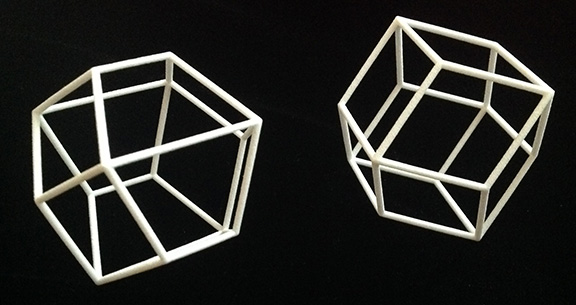
Dear Roger: In the model that you have before you, all the links-between-nodes have the same length. However, the rhombic dodecahedron has a twin (an almost identical twin) all the main features are the same except half of the 12 faces are trapezoids ---so that there are some extra-long arms and some extra-short arms. The structure is called the rhombic-trapezoid dodecahedron. AND AMAZINGLY THESE TWO STRUCTURES STILL FIT TOGETHER TOTALLY (when packed together according to a basic geometric asymmetry, there are no gaps in between). And the major and minor nodes are still the same (6 of one and 8 of the other). The dodec you hold in your hand (and its asymmetrical twin) are the only polyhedra that can be packed together so that they completely fill a volume of space! Except, of course, the cube.
3-D Models
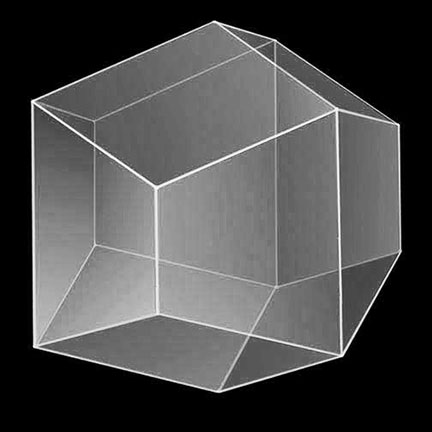
trapezoid dodecahedron rhombic dodecahedron---------------------------
7-4-09 rf to cr; (cr response)
Dear Conrad: Your 2D models are quite descriptive and adequate but to really decipher images/DSSU a strong 3D model cluster will be necessary; plus, I believe, it's important that you focus on the Coma-Leo cluster since 8 discovered nodes appear to me very important: they are observational cues that invite the attention of astronomers.
I agree. But a considerable amount of research is required. For instance, more confirmation is needed as to which nodes are major and which are minor ---which means trying to trace the branches of the galaxy clusters. Specialized computer plotting software would be needed. Again, work for an astronomer.------------------------
9-18-09 cr to rf (theory)
Dear Roger: I like your metaphorical description: ... the "octahedral gravitational cell" with it's 6 gravity lobes, as you point out "extending into six voids" (like the 'Ghost in the Machine'). And like the last movement in a Beethoven symphony--your breathtaking view of an entire orchestra of gravity cells accelerating and meeting in what you describe "as the ultimate cannibalistic implosion". I find this vision aesthetically satisfying, awesome and brilliantly conceived"
---------------------------
9-19-09 rf to cr (theory)
Dear Conrad: Oh, yes, I'm very aware that the gravity lobes inside each Cosmic cell are for the most part invisible because that is where the real beauty and mystery lies; which is what I really meant by my 'Ghost in the Machine comment. There is something ineffably ecstatic about the driven dual reality of invisible mysterious Lambda space gathering from within each cosmic cell void like some perfect storm in the dark and emerging into visible luminous radiation jewels against the spatial fabric of night. I am awed because I now can visualize this!
--------------------------9-27-09 cr to rf
Dear Roger: Yesterday I sent off the specially formatted source document of the Einstein Paper. Every equation as well as every mathematical symbol had to be captured as a "Math Type [software]" expression. All in all, a fair amount of work on a computer that occasionally won't co-operate.---Regarding your description of the gravity cells: Glad to see you are keeping it clear and consistent. Gravity cells have vertices (location points due to geometry); while structural cells have nodes (locations with significant matter concentration).
--------------------------
10-05-09 cr to rf (research)
Dear Roger, As you may know from images/DSSU theory, the prediction is that the maximum allowable intrinsic speed of galaxies is close to 3,000 km/sec. I just did the calculation: Galaxy ngc4522 has a speed of 2,800 km/sec!! The galaxy you have found is an excellent example of cosmic motion in the maximum range. I will use it as an example, to support this aspect of images/DSSU theory. As I have mentioned to you before, I was always too busy to spend a lot of time searching for supporting evidence of the many predictions ---but I was always confident that the evidence is there. Your research is invaluable and Right on!
--------------------------
10-16-09 rf to cr (on dodec identity)
Dear Conrad...I opened Chapter 22 and spent most of the day reading it several times. I now understand the rhombic and trapezoidal distinctions and closest packing issues. I understand the dual distinctions of both shapes which is profoundly beautiful. So too the packing of spheres into sequential layers resulting in random arrangements. And it is clearer to me how vital it is to understand and thus visualize why major and minor nodal structures (having answered the question of circumscribing spheres) are so important to the overall geometric configurations we are observing. The overlap of astronomical line-of site particularly. Of course there would exist a dense overlap of nodes in view of a thicket of major, minor nodal sharing. I get it.
----------------------------------------
2-12-10 rf to cr Cosmic Cell Interactive Digital Project
Dear Conrad: I will be posting soon, an improved zoom technique for flying through rhombic dodec's (the majority of them on the web are simply spinning dodecs, static views and boring. This one will approach and fly through a dodec with the capacity to take snapshots' along the way. I wanted this so I could control all positions and views (freeze them in place) in order to apply my paint brush to fashion anything we might imagine. The dodec will also be created in 3 modes against a black background: 1) a pure geometric presentation with the above capabilities, 2) the dodec with finely rendered spines (edges) with an emphasis more on node clusters that will clearly stand out in space. 3) A stereoscopic version of this as an Anaglyph (red blue glasses for stereopsis). This will eventually lead to the Galactic realism that I visualize in my minds eye.
--------------------
Please Note: interactive links do not exist - seeking originals done with outdated Flash software unfortunately no longer function) ---rf
3-29-10 rf to cr
Dear Conrad, Here is the link on the promised dodec demo:
Anaglyphic stereoscopic version:
http://ferragallo.com/rhombicdodec/rdodec1_ana.html (alas,links do not exisit- seeking originals?)rf
Non-anaglyphic version:
http://ferragallo.com/rhombicdodec/rdodec1.htmlThe rdodec1_ana.html may not open up (Anaglyphic Stereoscopic version). This problem will be fixed on Monday and you should have it soon. The Non-anaglyphic version works fine. Controls are as follows:
Page Up _Down controls zooming in and out
Arrow Keys Left_ Right controls rotation
You can hold keys down with LR arrows and page up--down to maneuver the dodec variously.
-----------------------------
4-27-10 rf to cr
http://www.ferragallo.com/dssu/dssuviz.html
Dear Conrad, Sending this off quickly...images/DSSU visualization process; an improved animated version to be controlled as follows:
Arrow Keys: rotate the dodec
Page Up & Page Down: zoom in and out
L: turns on &r off the dodec lines leaving only the particles
P: turns on & off the node particle effects
1st scenario: particle effects (gravitationally) drawn to each node correction.
2nd scenario: will see the dodec lines appear as sparkly filament lines that 'move' towards each nodal gravity inflow;
3rd scenario: Lambda out flow from a black hole dodec center which will see a subtle, rather mysterious mass flow (very subtle fog-like sparkle mass) moving towards each dodec filament line.... the entire dodec now in dynamic continuous motion!
*stay tuned changes will be completed soon with time enough for input as needed.
--------------------------------
3-21-11 cr to rf
Dear Roger: As always, I have much more to discuss with you than I can fit in here, in this brief email. -----Thank you ever so kindly for your offer to review chapters and prepare an image for the book. I have not yet decided on an image for the cover; if you have any thoughts on this let me know. I’m looking forward to this project, but for now I’m focusing on the journal (and since it is going to Physics Essays I’m quite confident it will be accepted; they have never rejected any of my papers).-------------------------------
Note: 2011-12 period was difficult period for both myself (house crisis, sale & resettlement 18 months) and Conrad (wife, Carol, surgery + year long medical rehabilitation)
Dear Roger, We are on the same wavelength (I've known it, of course, for a long time). Even though we've been out of touch. Thank you for your enquiries of concern. Carol is continuing with her recovery.
Congratulations on the ASCI acceptance of your work.
A few weeks ago the following paper was accepted for publication:
Contradiction Divides Two Aether Theories. It will appear in Physics Essays in the September issue (Vol 24, No.3).........Meanwhile, the paper submitted OVER ONE YEAR AGO is still under review (I have recently submitted my response to round #6)! I'm referring to the Paper Extended Relativity ---Exploiting the Loopholes in Einstein's Relativity. Just to remind you, all my new papers are posted in the "NEW ITEMS" section of my Website and are kept there for a few months. When a paper is accepted (by Physics Essays) I have to disable the link for that particular paper for six months. If you want a copy of an unlinked paper, just let me know and I'll send you the PDF file.
Early Model Building 2010 -- 2013
The Cosmic Cell (ferragallo)
Single Cell Rhombic Dodecahedron (RD) Models
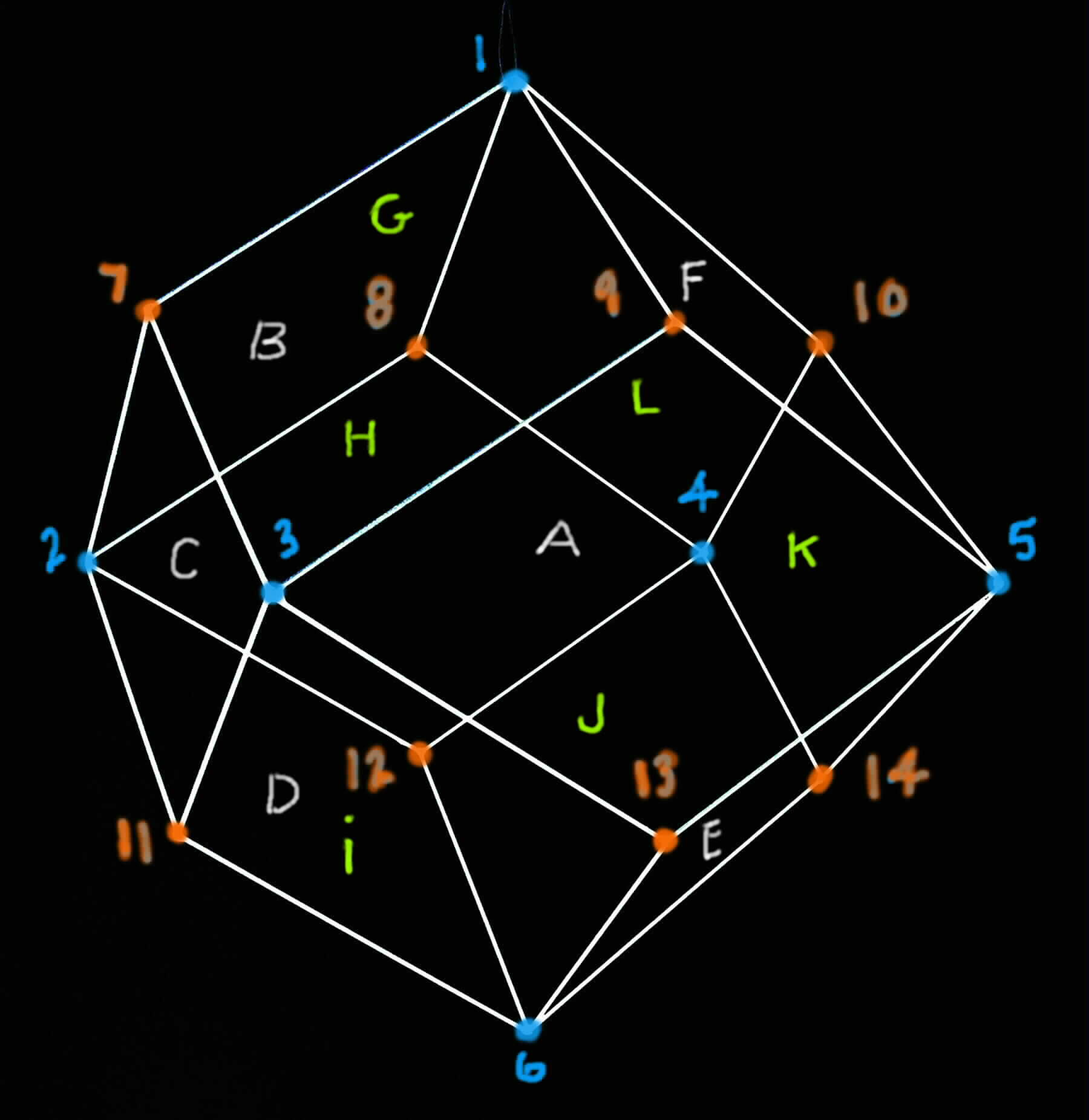
*12 face planes (see cardboard model)
*14 vertices (nodes/galaxy clusters)
*24 edges (filaments/edges)
.
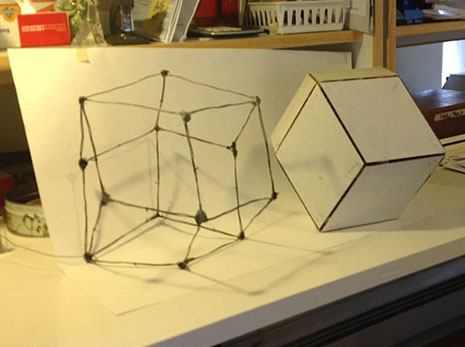
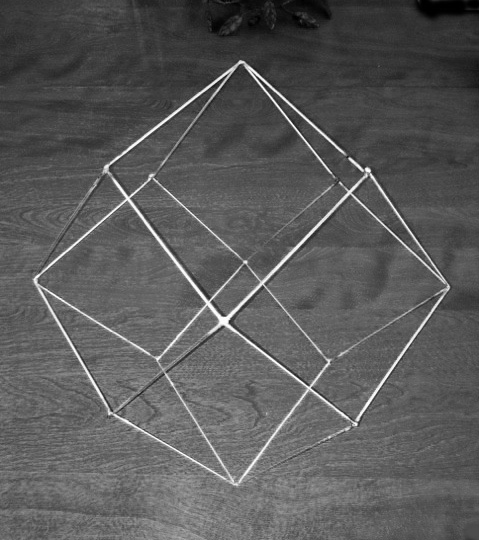
1. Early RD 3-D models 2. RD welded 3-D steel Model
2010 2012-13 Note: (vertices (nodes) are galactic cluster sites)
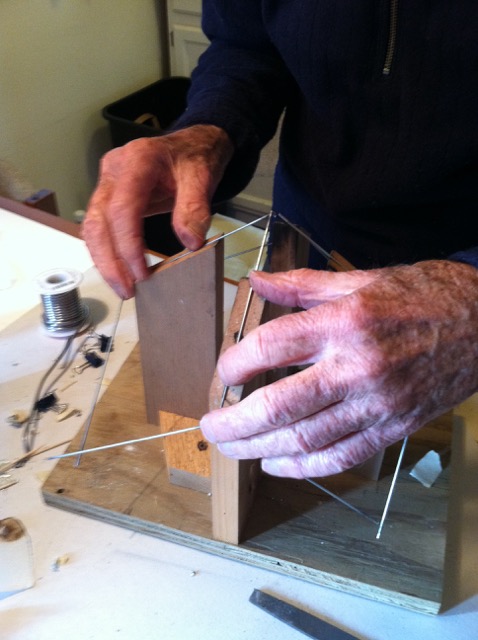
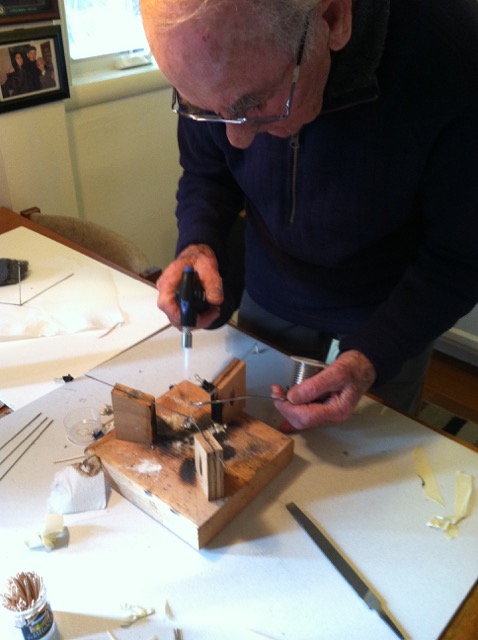
welding process 5-5-13 rf to cr
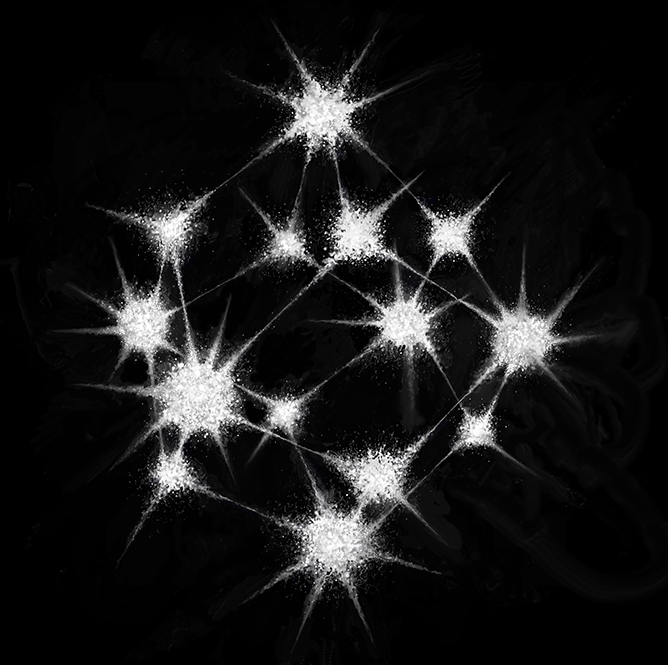
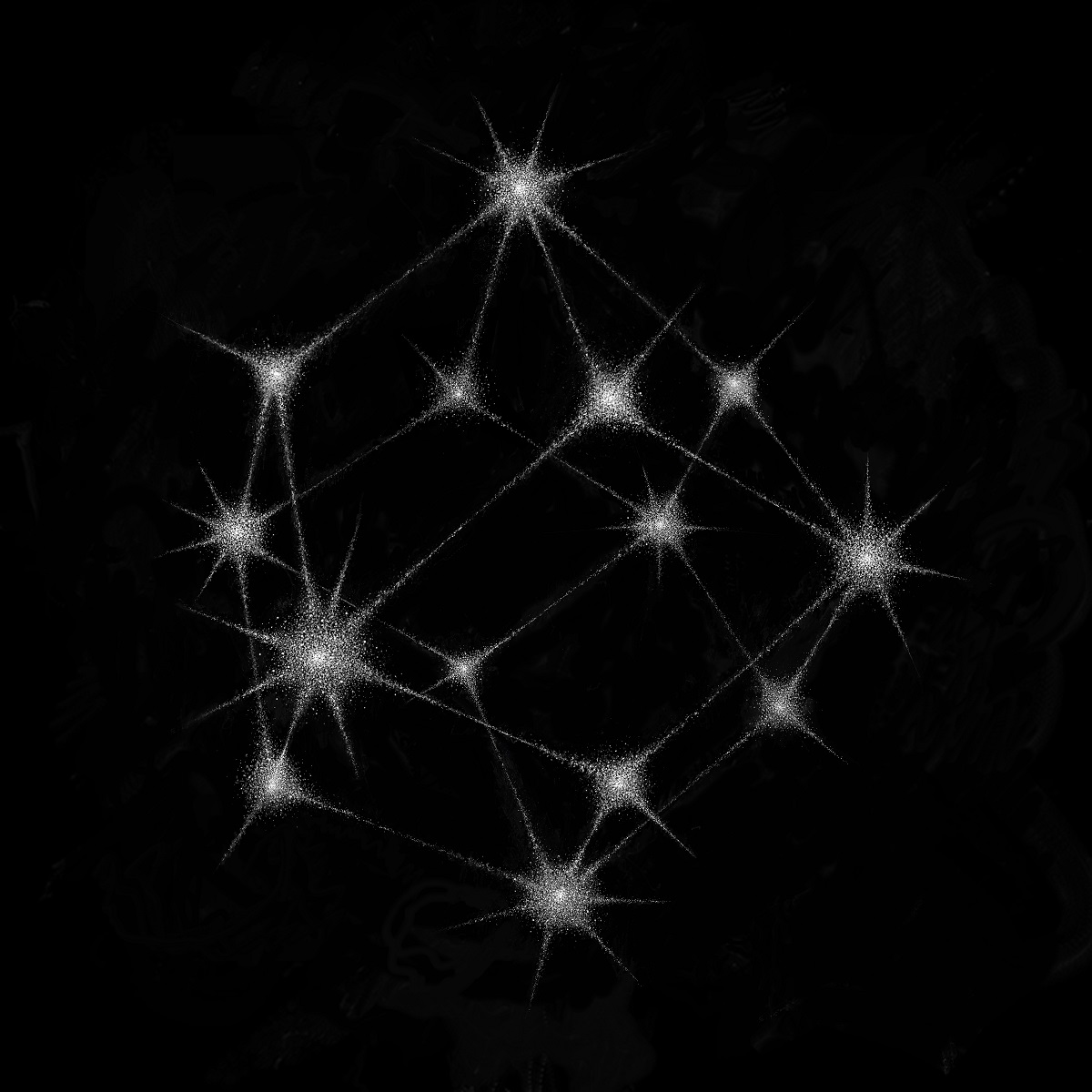
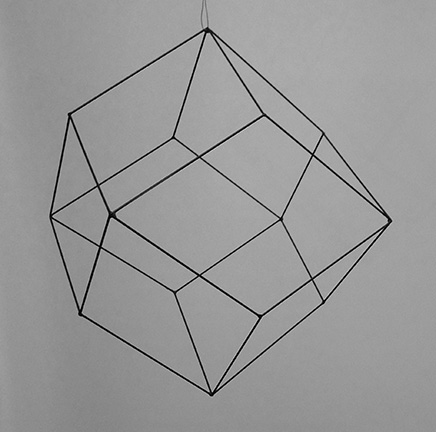
5-5-13 rf to cr physical and computer model period (model 12 inch welded steel wire: combined photographic & digital treatment)
One (rhombic dodecahedron RD represents one Cosmic Cell with 14 nodes (vertices)
(Nodes: 14 super galactic clusters at each vertice)
Note: Major nodes have 6 branches--Minor nodes have 8 branches. rf
Clarification (above): (dismiss, for a moment, the cosmic RD ghostly dodec steady state armature: imagine only the galaxy clusters (nodes) viewed line-of-sight, as far as Hubble eyes can see: untold billions of RD cosmic cells depicted here but en-masse in 3-D space: steady
state voids measuring 350 million light years diameter throughout interstellar space! (why Hubble eyes view a cacophony of filaments, voids and super galaxy clusters throughout interstellar space) A Void is the space within each cosmic cell (to be defined, images/DSSU theory) rf
Clustered Cosmic Cell Models - 2013-14
4-16-13 cr to rf
Dear Roger,
Hope this helps in clarifying things:
+1. 4/7/13: I have yet to visualize the connectivity of the 3 RD related cousins: rhombic-trapezoid-dodec, tetrahedron, octahedron. You will be demonstrating inside the book how these 3 cousins connect in concert together in 3D space RD to RD filament edges and nodes in masse?
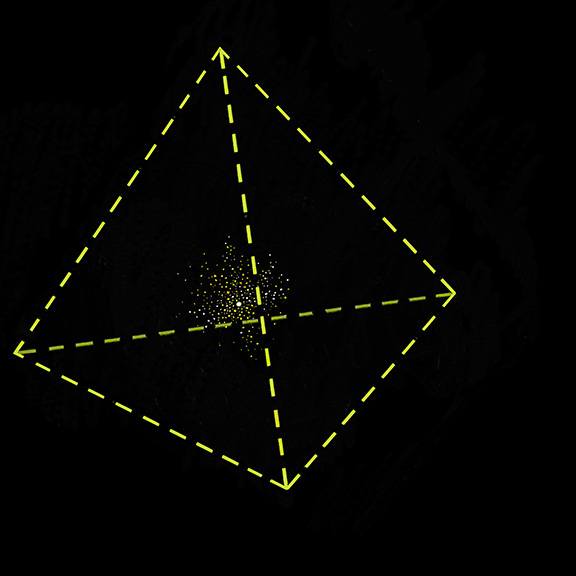
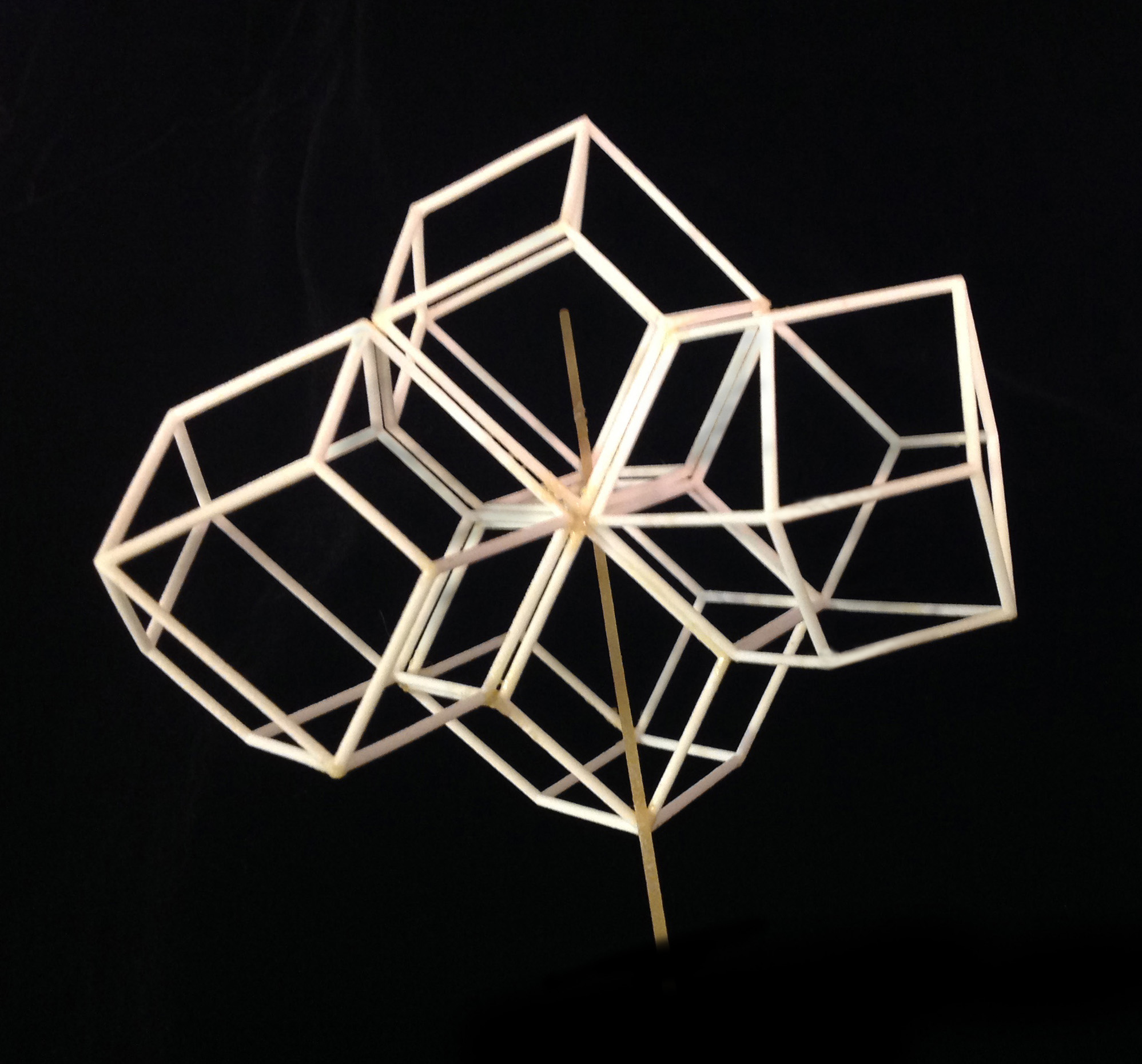
DON’T try to relate the rhombic-trapezoid-dodec with the tetrahedron and the octahedron; the tetra and octa would necessarily have to be distorted. The basic rhombic dodecs relate to the tetra as follows: Join 4 rhombic dodecs at one MINOR node (can be done with 4 models); now imagine drawing lines joining the four void centers; there would have to be six lines; these represent the six edges of a tetrahedron. Voilà, a tetra cosmic gravity cell with a “minor” nodal galaxy cluster at its center.
The basic rhombic dodecs relate to the octa as follows: Join 6 rhombic dodecs at one MAJOR node (can be done with 6 models); now imagine drawing lines joining the SIX void centers (these lines must pass through rhombic faces); there would have to be 12 lines; these represent the 12 edges of an octahedron. Voilà, an octa cosmic gravity cell with a “major” nodal galaxy cluster at its center.
+2. This relates to my wanting to construct a super mass of individual cell RD's, 13 in all, each of which will be 12 inches in diameter or perhaps larger? (and yes, I intended to include their important gravity cells). Should this array be larger than 13 to be effective? I've mentioned, my intent is to create a sculpture to be eventually exhibited. I'm still debating size/scale and need your input?
---I would probably go with some sort of hanging and loosely-connected structure (easier to picture; easier to work with; easier to modify).
---I think we determined, a while back, that Lucite balls will not work.
+3. I find good reason to construct one very large singular RD cell (perhaps a 36 or 48 inch wide physical model) that would be helpful to give some clear example of where the RTD's, tetra's and Octahedron's play their role within the model; of course to include something located at the precise dodec center to represent the gravity cell (possibly done with pulsing illumination).
---The precise center of the dodec is a gravitational NULL point. It is where 8 tetrahedra and 6 octahedra meet.
+4. You wrote the following on 4/11: Notice how the filamentous galaxy structures form the EDGES of the two dodecahedra.
I only see the 8 filament radial’s spread throughout your render with connective face planes everywhere. I draw no clear distinction from your 2D representation anything being internal or external? You must mean by galaxy structures the "radials" I've identified above; "internal" and "external" to mean the filament arms?
---YES---Every dodec node, by definition, represents the center of a cosmic gravity cell; a tetra at minor nodes, an octa at major nodes.
dynamic pathways. I may be answering my own question since I'm placing too much attention only on the RD which from day one dominated my understanding of the images/DSSU basic cell as the dominant massive polyhedron when I should have realized the RD is contextually bound in a holistic dynamic unity; clearly seen in your cover illustration.
---Glad you noticed that. My drawing is incomplete. The edges of the dodecs need to be highlighted (I mentioned that in the email) since they represent the filamentous galaxy structures.
Thanks, Conrad
----------------------------------
5-31-13 rf to cr
Dear Conrad, I’m proceeding ahead with the welded 12 inch diameter, 1/16 inch wire frame RD’s. Twelve should make quite a cluster! Perhaps by fashioning with string or fine wire it will be possible to reveal the invisible gravity wells. A solution to visualizing this within the models will require experiment.
--------------------
7-4-13 rf to cr
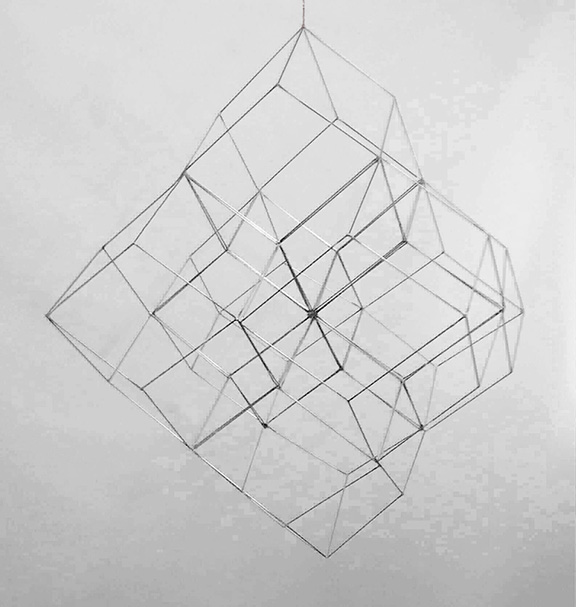
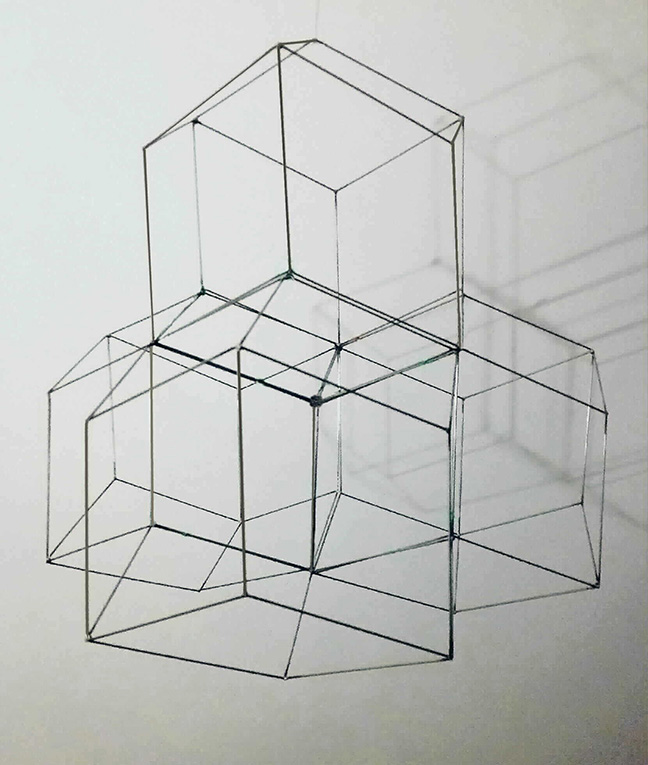
Dear Conrad, I have completed welding ten,1/16th in,x 12 inch steel wire cosmic cell RD’s and have packed them together into tetra and octa clusters as recommended. They hang from my studio ceiling. This laborious model building caused me to profoundly understand why it is that astronomers see voids, astral filaments, galaxy clusters throughout the deep reaches of interstellar space. Without the physical model, this artist would not have appreciated why order and chaos are such intimate companions at astronomical scales. My model drew from me the visceral sense of astonishment why, with images/DSSU, we see the "chaotic apparent in contrast to the underlying orderly actuality" in deep space. I immediately felt the profound reality we witness as universe. I remain awe-struck!
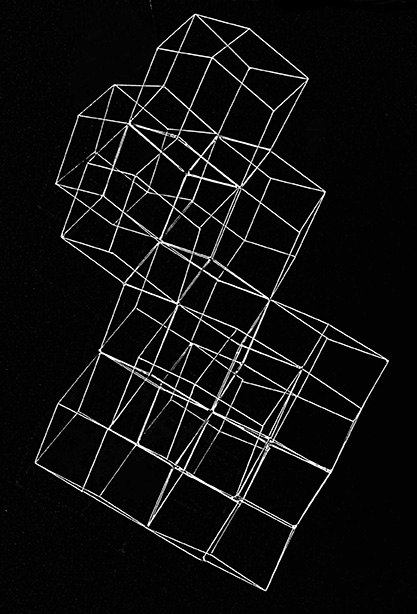
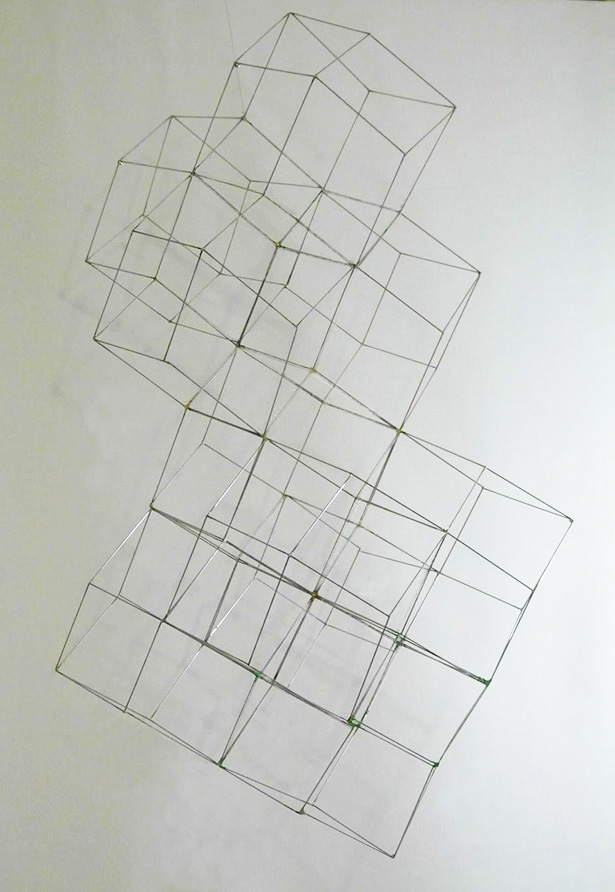
Digital RD Octa cosmic cell cluster Welded Steel Wire Sculpture
12 total cosmic cells, ea. 12 "
Approx; 8ft x 4 ft (suspended)RD Tetra (top) Octa (bottom)
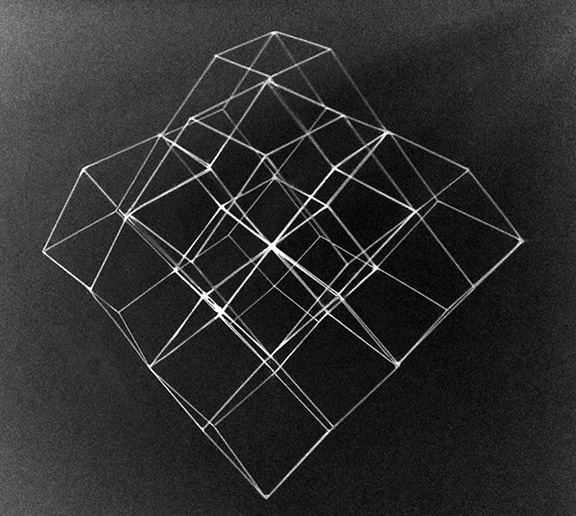
(Digitized) RD Octa cosmic cell cluster Welded Steel Wire Sculpture (Octa)
(varied view - 8 RD cosmic cells) (varied view - 8 RD cosmic cells)
Approx; 4.5 ft wide (suspended)
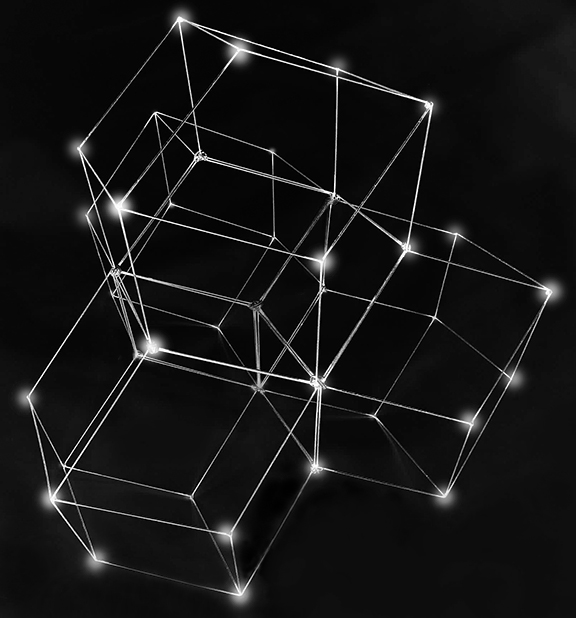
Digitized RD Tetra Cosmic Cell Cluster Welded Steel Wire Cluster
(varied view - 4 cosmic cells (Varied view - 4 cosmic cells)
(note galactic gravity sinks) Approx. 3 ft sq. (suspended)------------------------------ (RD Tetra)
8-7-13 cr to rf
Dear Roger, The stereoscopic method you discussed in a previous email sounds useful and may be applicable to presenting the theme of chaotic apparent in contrast to the underlying orderly actuality. … Maybe also for presenting the 3-D flows within a single unified gravity cell (with its dynamic debris flow).
Comment: I think the multi-dodec cluster you have constructed would be useful in layering (via your imaging software) to achieve the depth for the Book cover ---a receding-to-infinity effect.
Comment: For project above, and to answer your question, I like the orientation of the dodec image that I embedded in the last, or 2nd last, email. It looks to me like an up-side-down version of the 4th image you sent last time (the image you had labeled as 4_IMG_0894.jpg). (I want the structure to look more or less round or oval, but without looking too symmetrical. As you know, from some angles it looks perfectly square!)
Received the good news today: “The Processes of Gravitation –the Cause and Mechanism of Gravitation” has been accepted for publication by the Open Access (British) Journal, Journal of Modern Physics and Applications. (Finally, after rejections by 6 other journals even with some positive reviews!)
---------------------------
8-8-13 rf to cr
Dear Conrad, Before launching project #1 please find the original dodec model and the 6 dodecs I sent to you last Sunday plus 5 new dodecs that should satisfy your requirements. I will do this in stages so you can follow the process and wind up with an image closer to what you visualize.
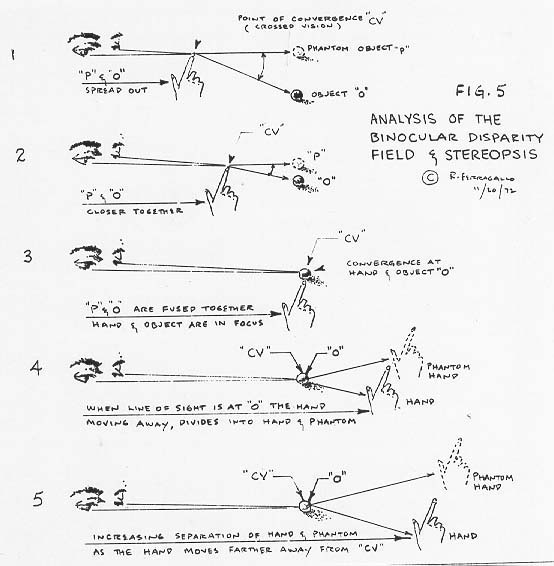
Yes, “stereoscopy” will work nicely to define visually the gravity cell shapes when I get into the tetrahedron and octahedron clusters. This should be a fine challenge to attempt this via stereopsis. I may be biting off a lot but I believe this can be done.
I’ve already tried a stereo-paired a single cell and succeeded in scribing the dodec center; from there, I should be able to render a gravity cell by simply free-viewing as I’ve done in the past.
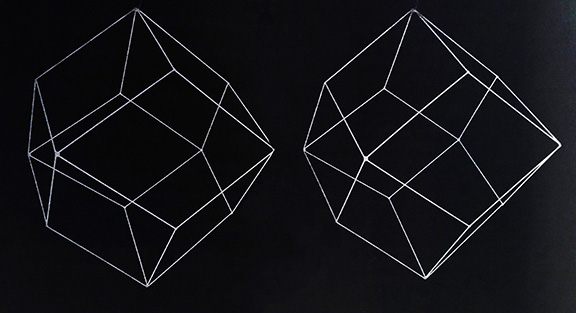
Stereoscopic-- Free Vision (cross-eye) One RD Cosmic Cell
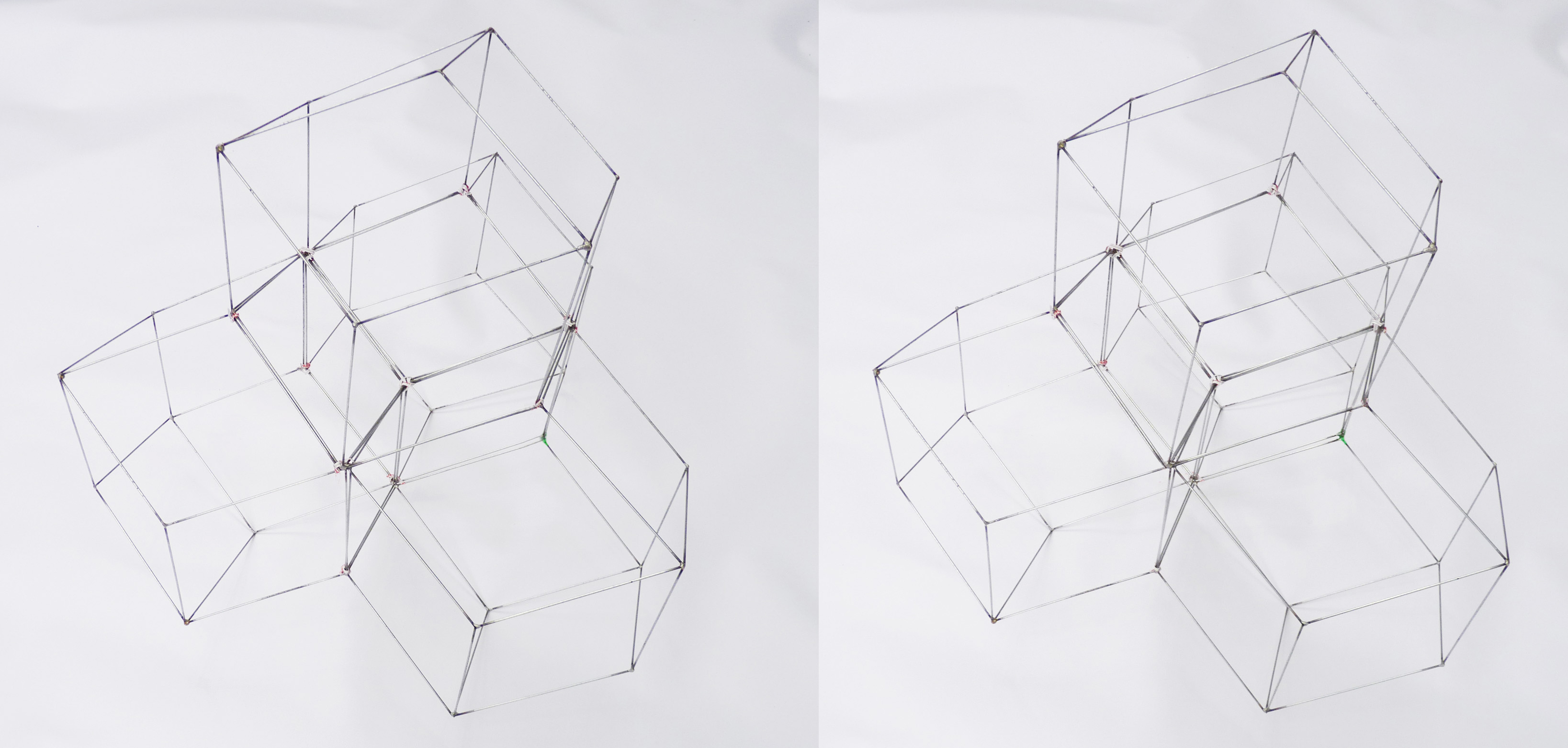
Free Vision (cross-eye method) RD Tetra (4 Cosmic Cell Cluster)
Photographed left-right (stereoscopic) view --- (Welded Steel Wire Sculpture)
(stereoscopic, cross vision method) www.ferragallo.com (stereo art)
Book Project: "Guide to the Construction of the Natural Universe" (Conrad Ranzan) 2013-14
4-2-13 cr to rf
Dear Roger, I've given the Book Cover illustration some serious thought and here is what I have come up with: Black background; translucent multi-faceted shapes (somewhat like the surface of a diamond but more chaotic) should fill just over one half of the canvas/cover starting strong in the lower right-hand corner and fading in size and intensity across the canvas moving diagonally upwards towards the left; with the translucence fadeing to blackness. Along the left edge of the canvas will be images of the four key geometric shapes: Rhombic dodec, rhombic-trapezoid dodec, octahedron, and tetrahedron. Each will be linked to the diamond-like chaotic region by a pair of projection lines (as if the polyhedron has zoomed out of that region).
Main elements: 1. Chaotic translucent region representing the RANDOM appearance of the Universe’s structure.
2. The four polyhedra representing the two cosmic structural cell-shapes and the two unified-gravity cell-shapes.
3. The paired projection lines represent the book’s thematic construction processes.
4. The black background is obviously appropriate to the subject of “the Universe”.
5. The title “Guide to the Construction of the Natural Universe” will appear in the upper right-hand sector (which region will be mostly black).
6. The diagonals of the "projection" lines and the diagonal aspect of the crystallized region symbolize the DYNAMIC aspect of the images/DSSU.
I'll try to prepare a sketch and send it to you. But I think the above description is reasonably straight forward.
-------------------------------
4-6-13 cr to rf
Dear Roger, .....You're absolutely right, the four key shapes should be in "3-D". They should be polyhedra stick-like or transparent-like structures. (I still have to prepare a sketch as a helpful guide for both of us; and to refer to in our discussions.) The translucent chaotic region should have considerable depth to it, if possible (so that here too we have a "3-D" effect).
Keep in mind, there is no rush on this. It should take me another six months before the book Manuscript is ready. So enjoy the artistic creativity.
----------------------------
4-11-13 cr to rf
.
The book-cover “draft” drawing is attached as a TIF image
---------------------------------------------------
5-27-13 cr to rf
Here is an important excerpt from the Book that explains why the Universe appears chaotic. (And this is why the artistic representations are both challenging and enlightening.): The images/DSSU natural construction, in sharp contrast, is built on order —the order of steady-state cell structure, the order of steady-state processes. The option it adopts is: the Universe really is orderly but only appears chaotic. So, why the apparent chaos? … Recall, the Universe is structured as dodecahedral cosmic cells which themselves are less-obviously configured as gravitation cells —the entire Universe is a dense packing of giant gravity cells. Now, everyone should be familiar with the concept of gravitational lensing —the distorting effect introduced when viewing something through a gravity field, especially when one’s line-of-sight passes through or near an intensely gravitating region. When astronomers view the Universe they are viewing everything through unavoidable gravitational lenses —the images/DSSU gravity cells being the lenses. The cellular structure means that the universe is entirely filled with gravitational lenses! The greater the distance, the more such lenses their line of sight encounters and the greater the distortion. It is like gazing through many layers of antique window glass with its waviness and thickness distortions; with the object of interest embedded in the last layer. The greater the viewing distance the greater the number of layers of such distorting panes. Is there any wonder the Universe appears chaotic? The Universe is intrinsically orderly; but its order is hidden. Its ordered structure is a treasure yet to be discovered.
-------------------------------
5-31-13 rf to cr
Dear Conrad: This late comment on the “why the Universe appears chaotic” excerpt you kindly sent me clarifies the science. I’ve re-read your excerpt and feel the need to compliment you for this beautifully written segment. If your forthcoming book is as clearly put forward as this sample, your book will be a winner! It has propelled me forward to further develop the concept visual I sent you. I now have in mind to enter the ASCI International with a painting quite similar to represent images/DSSU for this exhibition if I feel the final result worthy. It must live up to your statement: “The Universe is intrinsically orderly, but its order is hidden. It’s ordered structure is a treasure yet to be discovered”. It gives me great pleasure to help visualize this treasure!
---------------------------------
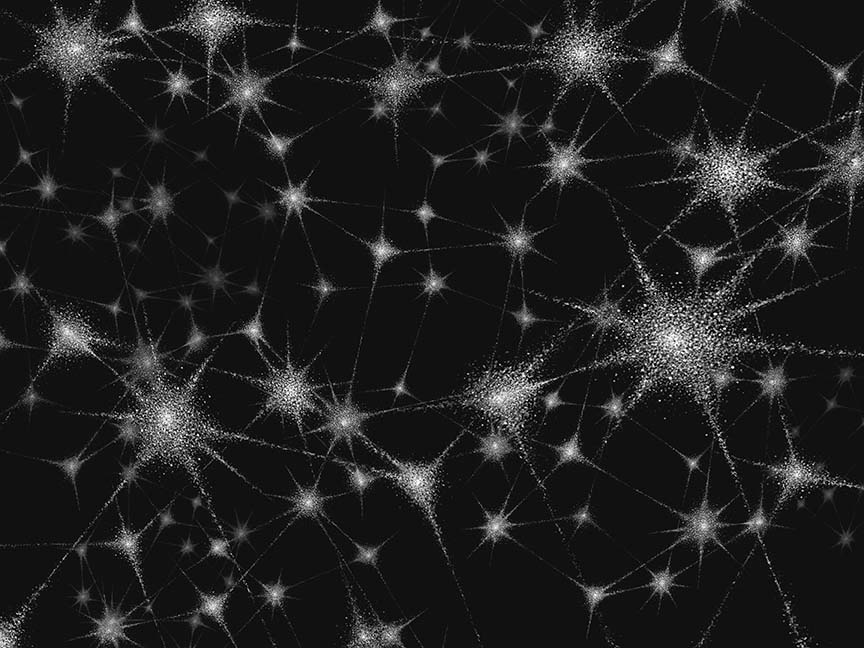
5-27-13 rf to cr
Dear Roger,
I don't know exactly how you do it but the image really looks good.
For diagrammatical effect, the thin filaments are good; for a more realistic effect the filaments should have the "galaxies" a bit more scattered. ("Galaxies", for the most part, originate and fall-in from the void regions. And then they zig-zag across the filament-line until the inevitable mergers.) The Book explains why the Universe appears chaotic. (And this is why the artistic representations are both challenging and enlightening.):
--------------------------------------
7-12-13 rf to cr
Dear Conrad, I’m in the heat of creating art pieces for ASCI Intl.13 with my choice seen below. images/DSSU. I spent the last couple of hours perusing the fine work done by astronomers on galactic superclusters. I’ve looked at these in the past but ever more closely today. Apparently the void that best represents our local group position is the “Sculpture Void”...Our local group appears positioned on a filament between the Fornax cluster and Virgo cluster
Ferragallo, 2013This painting enjoys a decade art science collaboration with eminent cosmologist, Conrad Ranzan, soon to publish "Guide to the Construction of the Natural Universe". His cellular Dynamic Steady State Universe (images/DSSU) departs from Big Bang orthodoxies I am in concert with. images/DSSU views our universe not as one unitary expanding colossus. It embraces astronomical observation, ie., a cellular array of huge voids, filaments and galactic clusters that incorporate connected (steady-state) rhombic dodecahedral cellular units which pack contiguously together gravitationally and stretch to infinity. My painting symbolically responds to the beauty and observational truth we inhabit a images/DSSU natural cellular universe. 100 words.Note: Poscript from Conrad Ranzan: 7-19-13
Dear Roger: Let me say, I am honored by your kind words.
A concise and comprehensible description is always challenging. I think you have done a good and accurate piece. So much depends on what one wishes to emphasis. This version puts the emphasis on expanding single-cell VERSUS non-expanding multi-cellular; and makes it clear that the dodecahedral aspect is hidden in the chaos:
[50 words:] The images/DSSU paradigm views our universe not as some colossal big-bang expanding single-cell but embraces a cosmic-scale non-expanding multi-cellularity in which 'natural' steady-state processes sustain great voids and a web-like network of galaxies and galaxy clusters. Hidden within this chaotic web is a rhombic dodecahedral cellular order stretching to infinity. (50 words)
-----------------------------------------
9-4-13 rf to cr (color 4)
Dear Conrad,
Intensified the aspects you recommended. I await your response whether or not you wish more “amplitude”, etc. and if the dimmed blotches are enough. My first tour was to proceed with caution. Again, let’s get this ever closer to what you envision. In my world art-science, interaction and collaboration rule.
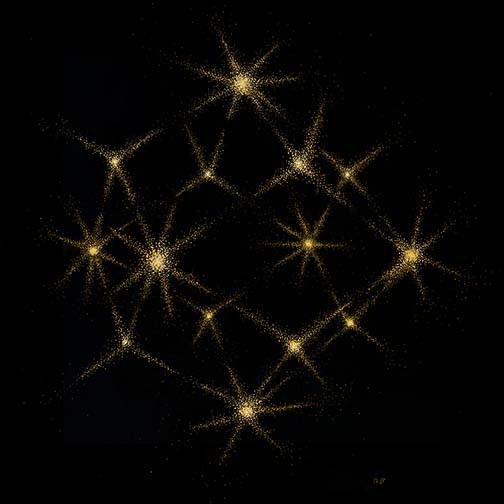
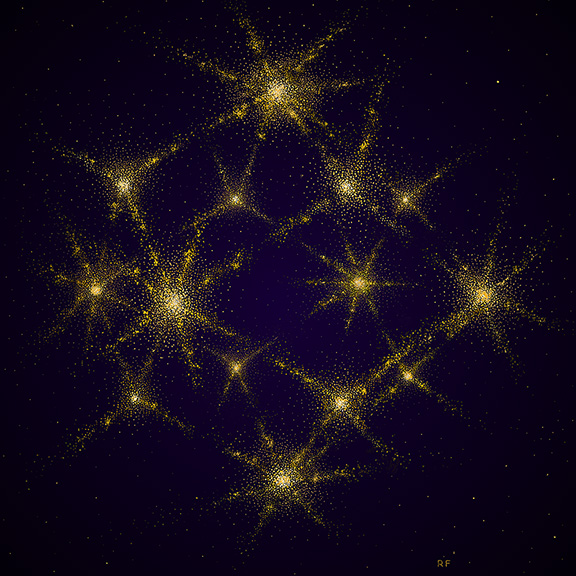
(book RD cell) #4 (book RD cell final version)
(book cover depth element)
---------------------------
9-19-13 cr to rf
Dear Roger, "B", "C", and "D" all look pretty good. Its hard to say which is best; maybe "Proj-1_D". They all contain some breaks or dark regions/patches along the filaments; this is good, provides some randomness, and gives the structure realism.
.
-------------------------
Dear Conrad, As always have at it. If it’s OK we will move on to the book cover and or do another version or two that matches how you see this. I do not have software that permits rendering actual glass material. I must work around this and thought of adding a glint or two but the glass effect looked tacky. The gradients can be handled variously of course. It began as a black and white model and then added some warm color tinting for a nice glassy effect.
-------------------------
10-22-13 cr to rf
Dear Roger, Book cover RD. Looks good. I agree, the transparent gradient shading works best. Would it be possible to apply a gold color to this image to match the realistic image? … and also to the corresponding wire-frame image?
The researching/reading I was referring to is ongoing. I try to collect examples and quotes of physicists’ bafflement. Also examples of unscientific extrapolations and speculations. Etc. … I often select stuff from the research items you send to me.
------------------------
10-28-13 rf to cr
Dear Conrad, Regarding project 1: yes, I can easily add the gold color as seen on the basic-frame image. As to the four 3D gradient polyhedra gracing the cover, I’ll follow your lead on this but it means doing away, at least for the cover, with the asymmetric RD example I created. I will render each polyhedron with gold gradients as per my 3D example. Do clarify this is what you want done before I tackle all four.
As for the lines, I’ll experiment with some kind of ‘pointiliated’ approach as you suggest. I will take care to make the network pattern identifiable. My first try with the entire cover looks quite good but the ‘patterns’ need greater clarity.
The TRD (trapezoid) that I show on the cover is just a drawing object. I need to know if I can utilize your “drawing” to render it in 3D with face planes as I will all 4 ‘cover’ polyhedrals. They should all look great in 3D as you’ve arrayed them.
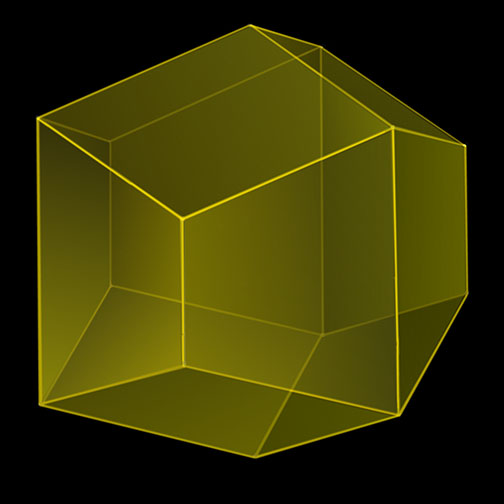
Book Cover Trapezoid Book Cover Rhombic Dodec
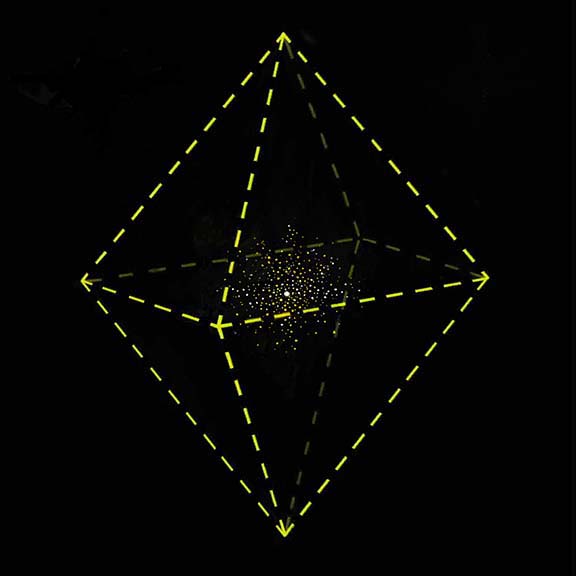
Cover Gravity Cell Octahedron Cover Gravity Cell Tetrahedron
------------------------------
10-28-13 cr to rf
Dear Roger, The 3D images look good and are nicely proportioned.
But recall my suggestion:
"I believe it would be best to delineate the Tetra and Octa shapes entirely with dashed lines (foreground lines strong, background lines faint) and no surface shading. This will give us a more accurate representation of the gravity cells, whose boundaries of edges and surfaces do not contain visible stuff (except as noted in the text). As you know, the boundaries of the gravity cells are invisible; while those of the structural cells are visible (as they do contain matter at edges and surfaces)."
10-31-13 rf to cr
Dear Conrad, Sending my first crack at the cover (done over a week ago) since it appears to me rather close to what you are describing... You should see this now because I was about to make it more “identifiable”! There are times when the first go around works best before art becomes overworked. Please dismiss the project 1 rd gradient which is, of course, not correct.. Let me know quickly if this example works for you.
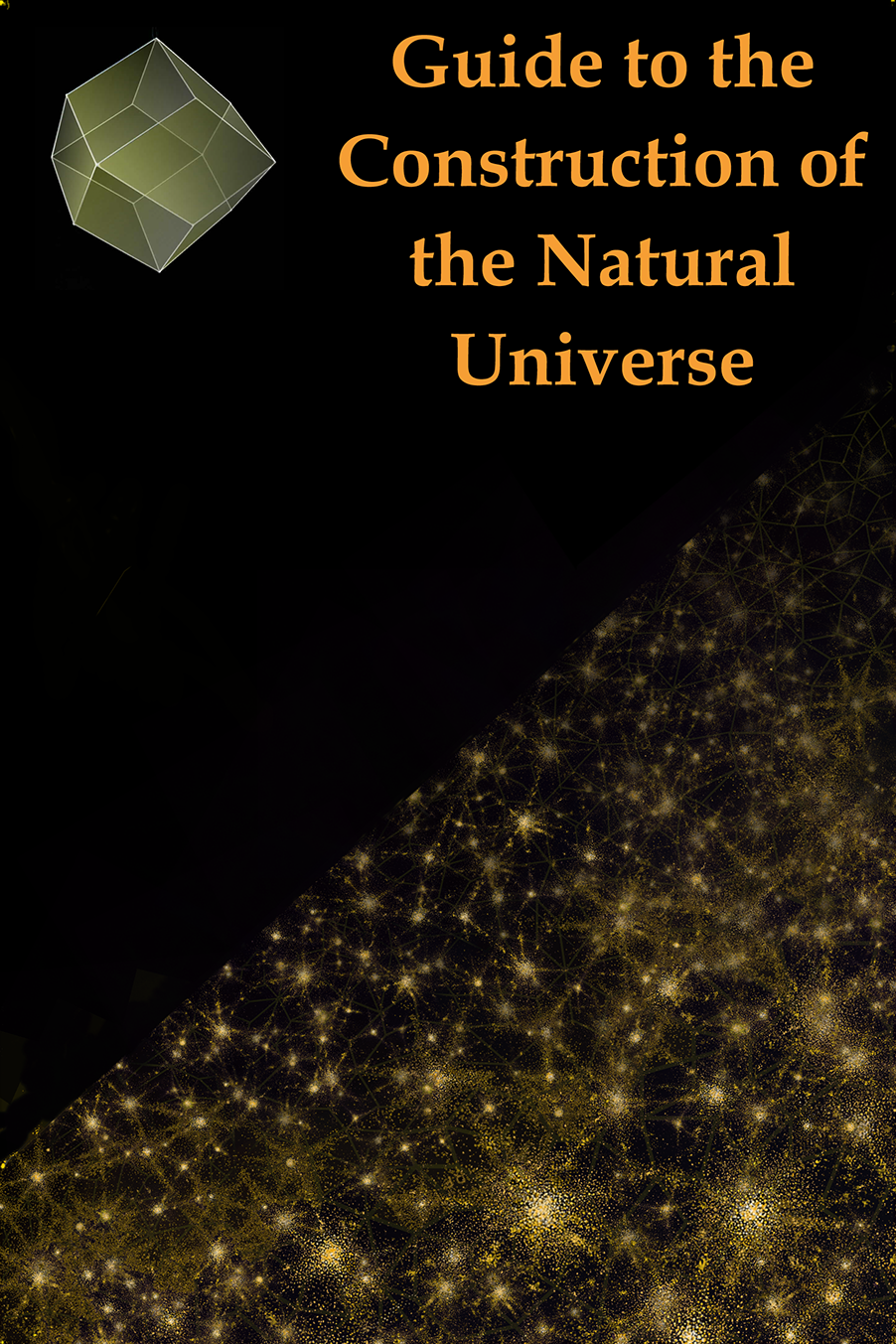
RF, First Book Cover layout RF, Book Cover Final 2014
11-3-13 cr to rf
It looks quite impressive, Roger. Very nice depth, and nice soft tone.
I realize that the difficulty is in getting just the right balance between core clusters and filamentary strung-out clusters. If anything, I would say there should be slightly more emphasis on filaments. (And if possible, try to have the core clusters slightly less roundish.)
3-D Printer Project - 2014
(To determine axial line of sight Rhombic/Trapazoid face plane relationship)
(Due to very difficult view points a physical model was necessary)
10-19-14 -------- 12-20-14
Left: Trapazoid Dodecahadron Right: Rhombic Dodecahadron
(3 inch models made with additive thermoplastic 3-D printing)
10-19-14 cr to rf
Dear Roger, In the normal stacking of cosmic cell dodecs there is always an end-to-end alignment of MAJOR NODES (but not of Minor nodes). This alignment is LINEAR. Think of it this way if you thread a bunch of rhombic dodecs onto a string ---like a string of pearls--- piercing through ONLY at/through opposite MAJOR nodes. The thread represents a straight line of sight.
[ ] Here is what I need to resolve: The question is when the stacking changes to a rhombic-trapezoid dodec where will that LINEAR line-of-sight pass through the far end of the added trapezoid-type dodec? Will it pass through a node or a face? (What is certain: is that it will NOT pass through another Major node.)
I think the only practical way to resolve this is with physical models. (And you’re the wireframe expert.) The line-of-sight clearly goes through the geometric centers of the rhombic dodecs. BUT I’m not sure if this is also true when one reaches (the line-of-sight extends into) the trapezoid-type dodec!